So, what even is a fractal?
the short version
A fractal is a shape that looks exactly the same no matter how far you zoom in. If you take a piece of it and blow it up, it's just the whole thing again but smaller. That's called self-similarity and it's the main trick. No matter how deep you go on the left, it keeps throwing the same spiky little triangles at you forever.
Unlike a circle that flattens into a line when you zoom in, fractals refuse to flatten out. They just keep throwing the same spiky details at you forever.
the koch snowflake
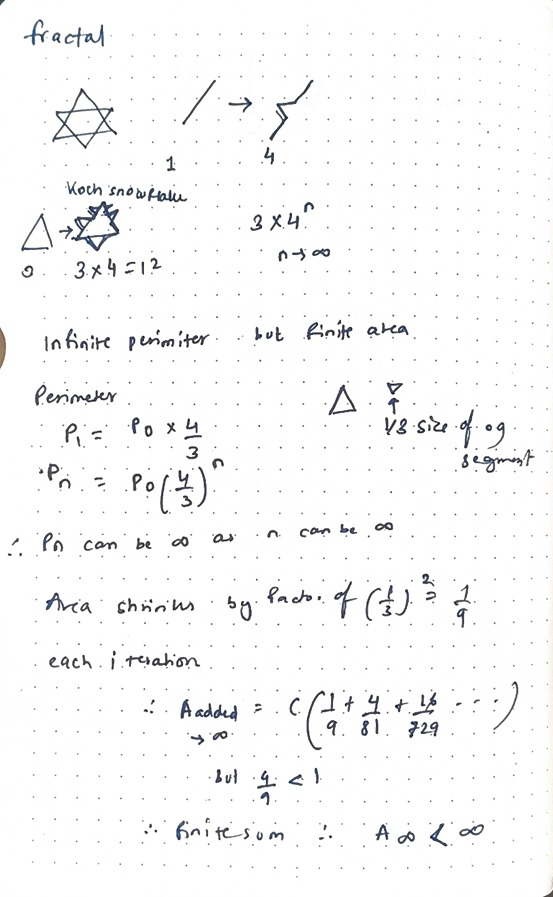
The rule is stupidly simple: Take a straight line, split it into three, and pop the middle third up into a triangular bump. Now you have 4 segments. Repeat forever.
Do this to all three sides of a starting triangle, and you get the snowflake.
here's the crazy part
Every time you repeat the step, the perimeter gets 4/3 times longer. It literally grows to infinity.
Pₙ = P₀ · (4/3)ⁿ perimeter goes to infinityBut wait — it still fits neatly inside a finite area on your screen.
A = (2√3⁄5) · s² area converges to a fixed numberInfinite perimeter, finite area. A border that never ends, wrapped around a space that does.
1.26 dimensions?
It's not a clean 1D line, and not quite a solid 2D shape either. It's stuck in between.
D = log(4) ⁄ log(3) ≈ 1.2619 4 self-similar copies, scaled down by 3This "fractal dimension" just measures how aggressively the shape fills space as you zoom.
by hitanshu [github]